
By: Sk Md Assad Armaan, Research Analyst, GSDN
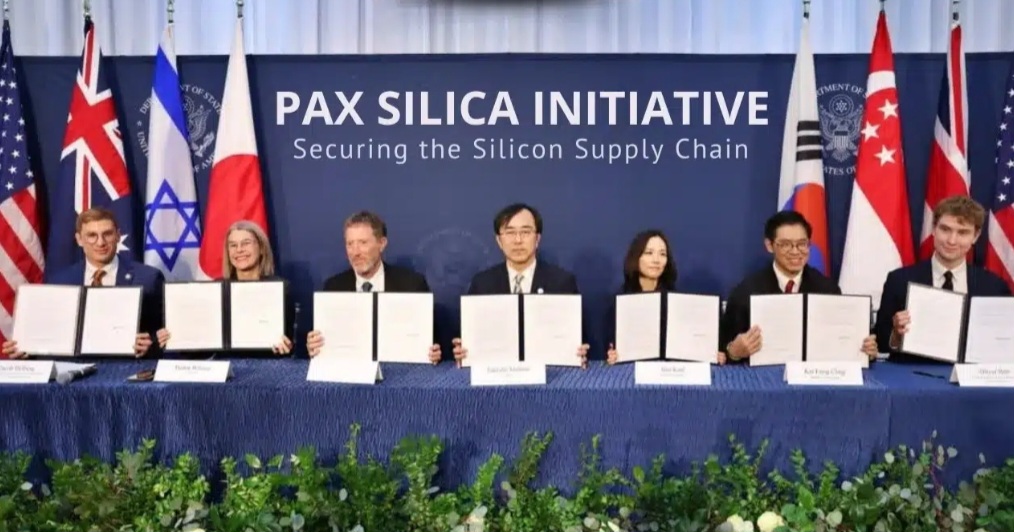
In the twenty-first century, global power is no longer defined by military strength or territorial control. Instead, it is increasingly shaped by technological dominance and control over digital infrastructure. Semiconductors, artificial intelligence, cloud computing, and data governance now form the backbone of economic productivity, military capability, and political influence. This transformation has given rise to what analysts describe as Pax Silica a technology centric global order led primarily by the United States and its allies, grounded in dominance over chips and digital standards. Much like Pax Americana once relied on military and financial supremacy, Pax Silica rests on technological superiority as the primary instrument of global influence. At the heart of this emerging order lies a strategic question with profound geopolitical implications: can Pax Silica meaningfully counter China’s rise as a technological and systemic rival? Rather than confronting China through direct military conflict, US and its partners have increasingly turned to technological containment restricting access to advanced chips, limiting knowledge transfers, and shaping global technology governance. These measures have undeniably introduced friction into China’s technological ascent. Yet they also expose the limits of containment in an era defined by scale, adaptation, and long-term strategic patience. Pax Silica may constrain, but whether it can decisively counter China remains deeply contested.
Technology as Power: How Pax Silica Seeks to Counter China
Pax Silica operates on simple logic: advanced technologies, particularly semiconductors and artificial intelligence, form the foundation of modern economic growth, military power, and geopolitical influence. Control over these technologies translates into leverage across global supply chains, defense systems, and future innovation pathways. In this framework, technological leadership becomes a substitute for territorial control, and access denial replaces traditional coercion. The most visible portrayal of this strategy has been the tightening of export controls on advanced semiconductor technologies. Restrictions on cutting-edge chips, chip-design software, and manufacturing equipment aim to slow China’s progress in high-performance computing and AI systems. Advanced lithography machines, produced by firms such as ASML, and fabrication capabilities concentrated in companies like TSMC, remain embedded within an ecosystem of allied states. Pax Silica seeks to use these chokepoints by ensuring that China remains downstream in the technological value chain. This approach reflects a deliberate attempt to weaponize interdependence. Rather than decoupling entirely, the United States accelerates its position at the global tech networks to impose selective constraints. Export controls, and supply-chain reshoring initiatives under policies such as the CHIPS and Science Act aim to preserve technological asymmetry without triggering open conflict. In theory, Pax Silica offers an efficient, low-cost method of strategic competition one that avoids military tension while imposing real constraints. In the short term, this strategy has produced tangible effects. Chinese firms face rising costs, limited access to AI training hardware, and engineering inefficiencies caused by reliance on older-generation chips. These constraints do not halt innovation, but they slow down its pace. Delays in AI model training, reduced computing power, and higher capital expenditure translate into strategic friction, particularly in sensitive domains such as military simulation, autonomous systems, and advanced surveillance technologies. Pax Silica thus succeeds as a form of temporal containment: it buys time for the United States and its allies to consolidate their technological lead while complicating China’s trajectory. Moreover, Pax Silica reinforces alliance cohesion. By coordinating export controls and setting shared standards among like-minded states, the United States constructs a rules-based technological environment that China must either adapt to or bypass. This collective approach enhances the credibility of technological containment in the near future. In this sense, Pax Silica does not merely constrain China it reshapes the structure of global technological competition itself.
Limits of Technological Containment: China’s Adaptation and the Boundaries of Pax Silica
Yet, technological containment faces fundamental limitations when applied to a state like China. Unlike smaller or economically dependent countries, China possesses the scale, resources, and political capacity to counter external pressure and respond strategically. Rather than collapsing under technological denial, Beijing has increasingly turned inward accelerating domestic innovation, expanding research and development, and framing technological self-reliance as a core national objective. One of the most significant factors undermining Pax Silica’s long-term effectiveness is China’s scale advantage. With a vast population, immense data-generation capacity, and centralized state coordination, China can compensate for technological constraints in ways that most countries cannot. In artificial intelligence development, access to massive datasets can partially mitigate limitations in hardware. Over time, this allows China to pursue alternative technological pathways rather than replicating Western models exactly. Technological pressure has also strengthened China’s political narrative of self-reliance. External restrictions are framed domestically not as evidence of vulnerability, but as justification for intensified national investment. This framing reduces political costs and mobilizes long-term state support for indigenous innovation. Paradoxically, Pax Silica risks accelerating the very decoupling it seeks to avoid pushing China toward a more autonomous and resilient technological ecosystem.
The deeper limitation of Pax Silica lies in its assumption that technological superiority alone can counter a systemic rival. Technology does not operate in isolation. Political systems, economic resilience, and demographic scale shape outcomes in long-term rivalries. China’s model of technological development differs fundamentally from that of liberal market economies. Whereas Pax Silica relies on private innovation governed by legal and ethical constraints, China integrates technology directly into state strategy. This enables rapid resource mobilization, tolerance for short-term inefficiencies, and prioritization of strategic outcomes over market logic. Additionally, Pax Silica depends on sustained alliance coordination with an inherently fragile foundation. Export controls and technology governance require long-term consensus among democracies with divergent economic interests. Any fragmentation within this coalition weakens the effectiveness of containment. China, by contrast, benefits from centralized decision-making. These asymmetries suggest that while Pax Silica can shape the pace and cost of China’s rise, it cannot decisively determine its outcome.
Strategic Insights: Global South and the China Question
Beyond bilateral competition, the effectiveness of Pax Silica also depends on how it shapes the broader global technological environment, particularly in the Global South. China’s technological rise is not confined to domestic innovation alone; it is deeply intertwined with its ability to export digital infrastructure, platforms, and standards across Asia, Africa, and Latin America. Through initiatives such as digital connectivity projects, smart city technologies, and affordable telecommunications infrastructure, China embeds itself within the technological ecosystems of developing states. This presents a structural challenge for Pax Silica. While advanced semiconductor controls target the upper end of the technology spectrum, much of China’s global influence operates at the middle and lower tiers, 5G networks, surveillance systems, digital payment platforms, and cloud services. For many Global South states, Chinese technology is not only cheaper but also bundled with financing, infrastructure, and political non-interference. Pax Silica, by contrast, offers technological superiority without always offering accessibility at scale. Standard-setting further complicates containment. Global governance bodies that define technical norms for telecommunications, data flows, and artificial intelligence are increasingly contested arenas. China’s active participation in international standards-setting institutions allows it to shape the technical rules that govern future digital systems. Even if Pax Silica maintains dominance over cutting-edge innovation, losing influence over standards risks eroding long-term leverage. Technological leadership without normative leadership produces an incomplete form of power.
Moreover, the perception of Pax Silica matters as much as its material strength. If technological containment is viewed by non-aligned states as exclusionary or protectionist, it may generate resistance rather than alignment. Many emerging economies seek access to technology, not participation in great-power rivalry. Without offering alternatives, Pax Silica risks reinforcing a fragmented digital order rather than consolidating global influence. These dynamic highlights a central paradox: the more Pax Silica focuses narrowly on denying China access to advanced technologies, the more space it may leave for China to consolidate influence elsewhere. Containment at the top of the value chain does not automatically translate into dominance across the broader digital arena. As a result, Pax Silica’s success in countering China depends not only on restriction, but on its capacity to provide attractive, scalable, and politically legitimate technological alternatives.
Conclusion: Constraint Without Containment
Pax Silica represents a significant evolution in how global power is exercised. By shifting strategic competition from military confrontation to technological dominance, it offers a means of managing rivalry without immediate escalation. In doing so, it has redefined the terrain of great-power competition for the digital age. Yet the evidence suggests that Pax Silica can delay and constrain, but not fully counter, China’s rise. Technological containment imposes costs and friction, but it does not neutralize the structural advantages of scale, and long-term strategic commitment that underpin China’s trajectory. Rather than preventing China’s ascent, Pax Silica reshapes it forcing adaptation rather than submission. The future global order will therefore not be decided by technological dominance alone. It will depend on how technology interacts with political legitimacy, economic resilience, and strategic vision. Pax Silica may define the rules of competition, but it cannot, by itself, determine the winner. The central question moving forward is not whether Pax Silica can counter China, but whether technological power without broader political consensus and global legitimacy can sustain a stable order in an increasingly fragmented world.



