
By: Sanya Singh, Research Analyst, GSDN
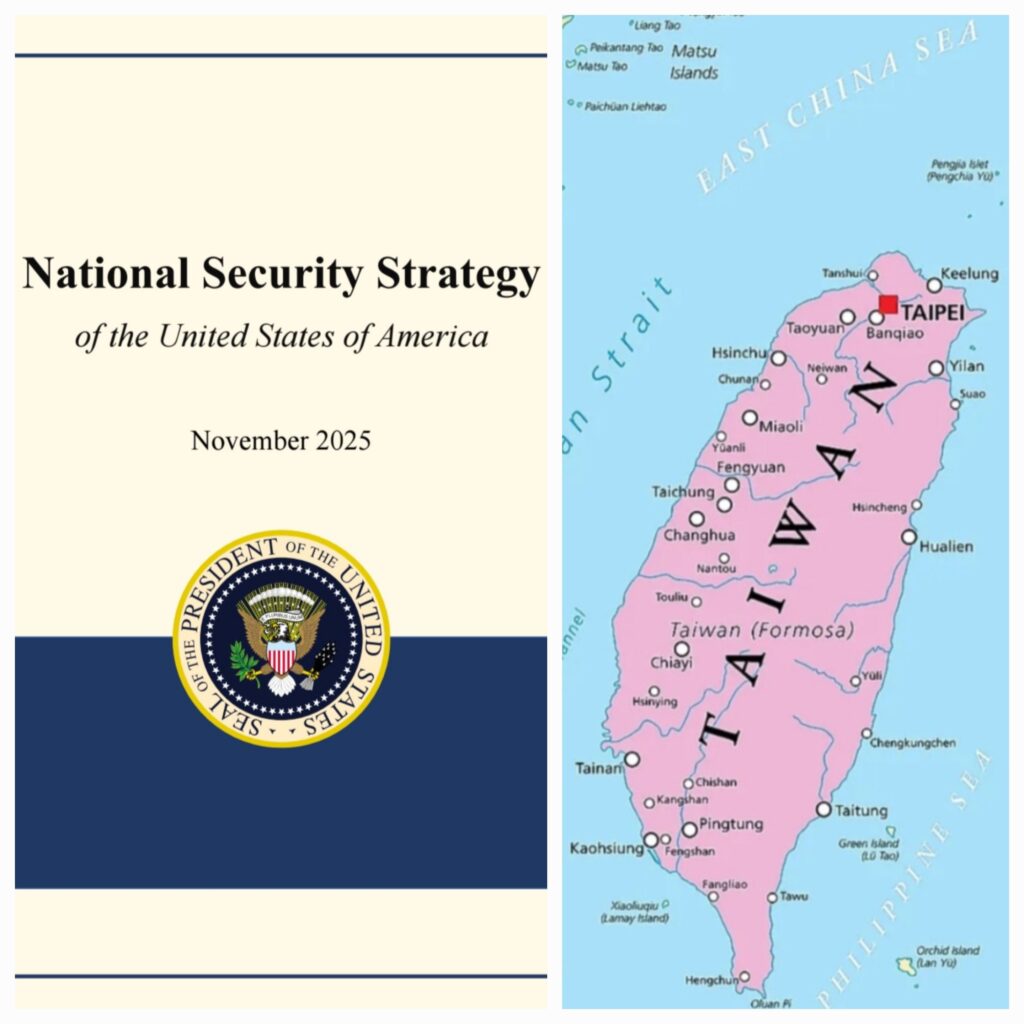
The strategic rivalry between the United States of America and the People’s Republic of China has become the central axis of international politics today. Among the many flashpoints arising from this rivalry, Taiwan remains the most dangerous and consequential. Taiwan’s political status, democratic identity, economic importance, and strategic location at the heart of the Indo-Pacific make it a focal point for regional stability and global security. As Washington articulates its National Security Strategy 2025 (NSS 2025), deterring a Chinese military attack on Taiwan stands as a core objective. The strategy is expected to outline how the United States of America intends to preserve peace, reassure allies, and manage competition with China without triggering a major war. This article examines whether the National Security Strategy 2025 (NSS 2025) is likely to deter China from attacking Taiwan by analysing the strategic environment, deterrence logic, military posture, economic and technological tools, alliance dynamics, diplomatic signalling, and the broader limitations that shape deterrence outcomes.
Strategic Context of National Security Strategy 2025
The National Security Strategy is the principal document through which the United States of America outlines its perception of threats and defines long-term priorities. By 2025, the international system will likely still be marked by persistent great power rivalry rather than periodic crisis. The rapid economic growth and technological advances of China, as well as large-scale military modernization, have finally positioned China to challenge the United States of America’s influence in various dimensions. The government in Washington increasingly characterizes Beijing’s actions as revisionist, with a particular emphasis on maritime Asia, as China pursues greater dominion over nearby waters and political outcomes.
Taiwan occupies a uniquely sensitive position within this strategic context. The Chinese leadership considers Taiwan as an integral part of the national territory and has proclaimed on several occasions that the issue cannot be passed on indefinitely to future generations. Over the past years, China has mounted pressure on Taiwan through military exercises, frequent air and naval operations near the island, cyber intrusions, and diplomatic efforts aimed at shrinking Taiwan’s international space. These activities aim at signalling resolve, testing responses, and gradually changing the status quo. The National Security Strategy 2025 (NSS 2025) is expected to frame Taiwan not only as a regional concern but also as a measure of the United States of America’s credibility and commitment in the Indo-Pacific.
Deterrence Theory and the United States of America’s Policy Toward Taiwan
Deterrence works by affecting an adversary’s calculus about cost, benefit, and probability of success. In the Taiwan scenario, deterrence is intended to persuade the PRC that any employment of force will result either in military defeat or in unacceptable political, economic, and strategic consequences. The integrated deterrence that will most probably be stressed in the National Security Strategy 2025 (NSS 2025) unites military capability, economic leverage, diplomatic coordination, technological robustness, and informational influence in one strategic framework.
The basis of the policy of the United States of America toward Taiwan has, for decades, been strategic ambiguity. It aims to deter the People’s Republic of China from using force while discouraging Taiwan from unilateral declarations of independence. Strategic ambiguity has contributed to stability in the past, but growing confidence and expanding military capabilities have raised doubts about its continued effectiveness. The National Security Strategy 2025 (NSS 2025) may therefore maintain ambiguity in formal statements while strengthening practical measures that enhance deterrence credibility and reduce incentives for aggression.
Military Foundations of Deterrence
Military power remains the most visible and immediate component of deterrence against a potential attack on Taiwan. The National Security Strategy 2025 (NSS 2025) is expected to give priority to the goal of maintaining a favourable balance of power in the Indo-Pacific region. It includes continuous investments in naval forces, airpower, long-range precision strike capabilities, missile defence systems, space resilience, and cyber operations. These assets are designed to deny China the ability to attain a quick or decisive victory in a conflict over Taiwan.
Force posture adjustments further reinforce deterrence: forward-deployed forces, rotational presence, and access improvements to regional facilities reduce response times and increase operational flexibility. Regular joint exercises with allies build interoperability and signal readiness. The National Security Strategy 2025 (NSS 2025) will probably highlight these measures as concrete expressions of determination and readiness.
Support for Taiwan’s self-defence capabilities is yet another key pillar of military deterrence. The United States of America has increasingly focused on providing asymmetric systems tailored to counter amphibious assaults and air operations. Capabilities such as mobile missile launchers, air defence platforms, maritime surveillance systems, and unmanned technologies are all supposed to increase the operational cost of any invasion. If effectively integrated into Taiwan’s defence planning, these capabilities strengthen deterrence by denial and complicate the Chinese military calculations.
Economic and Technological Aspects of Deterrence
In the modern strategic competition, deterrence is no longer confined to traditional military spheres. Economic strength and technological leadership are increasingly vital in determining national power and strategic consequence. Taiwan’s preeminence in advanced semiconductor fabrication grants it an exceptional status in the international economy. Any disruption to Taiwan’s semiconductor output would impact supply chains crucial for everything from consumer electronics to leading-edge weapons systems.
The National Security Strategy 2025 (NSS 2025) will likely identify economic resilience and technological security as integral to national defence. Investments in domestic manufacturing capacity, supply chain diversification, and research and development would reduce vulnerabilities, with close technological cooperation with trusted partners, such as Taiwan, being retained. In this way, economic interdependence will not be able to develop into a strategic vulnerability.
Second, economic deterrence encompasses the credible threat of collective sanctions and trade restrictions should aggression occur. Sanctions against a large economy such as China would be costly for all parties involved, but the threat of prolonged economic harm may help alter the Chinese decision calculus. The forthcoming National Security Strategy 2025 ( NSS 2025) will probably highlight multilateral coordination as key to making economic deterrence plausible and impactful.
Alliance and Partnerships in the Indo-Pacific
The alliance remains one of the greatest strategic advantages of the United States of America. The National Security Strategy 2025 is likely to reiterate that alliances magnify deterrence through the sharing of burdens, pooling capabilities, and signalling collective resolve. In the Taiwan context, Japan’s role is particularly significant due to its geographic proximity and its own security concerns regarding regional stability.
There is also a need to enhance defence cooperation, intelligence sharing, and joint planning with the allies to increase the credibility of deterrence. Strengthening the partnership with Australia, the Philippines, and other regional actors further complicated China’s strategic calculus. The possibility that a conflict over Taiwan could escalate into a broader regional confrontation increases the potential costs of aggression and hence reinforces deterrence.
Similarly, minilateral frameworks and flexible coalitions will also be featured prominently in the National Security Strategy 2025. Minilateral arrangements enable targeted cooperation on discreet security challenges without a set of formal obligations required of traditional alliances. Collectively, these partnerships demonstrate unity of purpose and reduce the likelihood that China could isolate Taiwan diplomatically or militarily.
Diplomatic Signalling and Crisis Management
Deterrence is a function not just of strength, but also of communication. Clear and consistent signalling reduces the prospect of misinterpretation and unintended escalation. The National Security Strategy 2025 (NSS 205) will likely reinforce commitments to channels of dialogue with China, including military communication mechanisms, as a means of crisis management to lower the risks of accidents or miscalculations during times of heightened tension.
At the same time, diplomatic engagement with Taiwan has gradually expanded. High-level interactions, trade initiatives, and support for Taiwan’s participation in international forums signal a sustained commitment without formally altering long-standing policy positions. These actions contribute to deterrence by showing that Taiwan is not isolated and that the United States of America remains invested in its security and resilience.
Limitations and Challenges of Deterrence
These steps notwithstanding, deterrence is intrinsically uncertain and manifoldly constrained. The Chinese leadership may feel that its increasing military power and degree of economic leverage decrease the risks of an attack against Taiwan. Domestic considerations of political nature, such as nationalism and regime legitimacy, may also influence strategic choices being made in Beijing.
Accelerating technological changes further complicate deterrence dynamics. Cyber operations, space capabilities, and information warfare blur the distinction between peace and conflict. Gray zone activities provide the possibility of incremental pressure without crossing thresholds toward a full-scale military response. The National Security Strategy 2025 (NSS 2025) must hence engage with a wide spectrum of challenges extending beyond conventional warfare scenarios.
Sustaining political will is another important factor. Deterrence is a function of credibility, and the latter depends on consistent policy, alliance cohesion, and commitment of resources for the long term. China will closely monitor domestic debates in the United States of America and political splits among allies in assessing whether intervention can be sustained in a Taiwan contingency.
Assessment of Deterrence Effectiveness
The effectiveness of the National Security Strategy 2025 (NSS 2025) at deterring China is, of course, a matter of perception. If Beijing believes that the costs of military action would exceed any potential gain, deterrence will likely hold. Integrated deterrence makes this approach more credible by melding military readiness with economic leverage, diplomatic coordination, and technological resilience.
However, deterrence is not a static condition. It requires a continuous adaptation to evolving circumstances and sustained investment over time. While the National Security Strategy 2025 (NSS 2025) can significantly lower the possibility of war, it is not possible to altogether eradicate the danger element. Strategic miscalculations, domestic pressures, or unforeseen crises could still undermine stability in the Taiwan Strait.
Broader Strategic Implications
Beyond immediate deterrence, the National Security Strategy 2025 (NSS 2025) shapes long-term expectations across the Indo-Pacific. The way in which the United States of America approaches the Taiwan issue informs regional views on questions of leadership, reliability, and commitment. A coherent and consistent strategy reassures allies and partners, while ambiguity or inconsistency could embolden hedging behaviour and foster strategic uncertainty.
The Taiwan Strait is also one of the most economically important maritime corridors in the world. Any conflict would disrupt trade flow, energy supplies, and financial markets on a global scale. Preventing conflict, therefore, supports not only regional security but also global economic stability and shared prosperity.
Domestic politics and strategic signalling play core roles in driving deterrence outcomes. Bipartisan concern about coercion in the Indo-Pacific in the United States of America strengthens deterrence through policy continuity. Nationalism and regime legitimacy are shaping risk tolerance in China, where signalling is a delicate matter as aggression would create sustained consequences.
Information warfare and strategic narratives also shape deterrence. Countering disinformation, reinforcing shared values, and supporting transparent communication strengthen international support for stability. Stability signalling through consistency, restraint, and preparedness remains essential for preventing miscalculation during periods of heightened tension. Success will depend over time on coordination across military planning, economic policy, alliance diplomacy, and sustained public communication. These reinforce credibility and strengthen deterrence. They produce durable regional stability and have served to manage competition responsibly, diminish escalation risks, and preserve strategic balance.
Conclusion
The National Security Strategy 2025 (NSS 2025) of the United States of America is designed to prevent an attack by China on Taiwan through an integrated approach that encompasses military strength, economic and technological tools, alliance networks, and disciplined diplomacy. Although deterrence can never be certain, a credible and sustained strategy dramatically increases the likelihood that peace and stability are maintained across the Taiwan Strait. To help manage competition, including preventing a conflict with profound consequences for regional and global security, the National Security Strategy 2025 (NSS 2025) reinforces the need for commitment, adaptability, and cooperation.



